The ROI of an MBA: A Practical Framework to Decide if It’s Worth It
February 1st, 2026
Business CareersCareer Advice

An MBA can be a rational investment, but only if you evaluate it the way you would any other material decision: define the objective, quantify the full cost (including time), model the likely upside, and pressure-test the assumptions.
Return on investment (ROI) is not a single universal figure for an MBA. It will vary based on your current compensation, the industry you want to move into, whether you keep working while studying, and how effectively you use the programme’s network and career resources.
What follows is a structured approach you can use to calculate your likely return and make a defensible decision, with both Irish and international data points to ground the analysis.
What “ROI of an MBA” actually means
In simple terms, ROI compares what you gain to what you spend. For educational purposes, it is more accurate to treat ROI as a multi‑year cash-flow question, not just a “salary bump” question. That is why serious analyses typically use concepts like payback period (how long until you recoup the investment) and net present value (NPV), which adjusts future gains for the time value of money. The OECD explicitly frames returns to tertiary education in terms of benefits net of taxes and contributions, costs (including foregone earnings), and NPV of future financial flows.
A practical way to think about MBA ROI is:
- Costs (direct + indirect) occur mainly during the programme.
- Benefits (compensation uplift + career acceleration) accrue over multiple years.
- Risk manifests as uncertainty about job outcomes, timing, and salary progression.
Step 1: Capture the full cost, not just tuition
Most ROI estimates fail because they undercount costs. Use a “total investment” view that includes:
Direct costs
- Tuition and required fees
- Books, materials, software, exams
- Travel (if there are in-person modules)
- Financing costs (interest, fees), if you borrow
Indirect costs (often the largest line item)
- Opportunity cost: income you forgo if you leave work or reduce hours
- Lost bonus/commission eligibility during study
- Reduced capacity for side income (contracting, consulting)
Business schools themselves often highlight “opportunity cost” as a critical variable and note that part-time or executive formats can reduce it by allowing you to keep earning while studying.
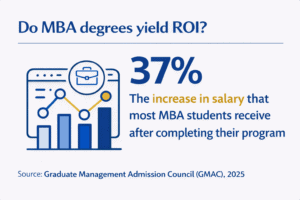
If you want a structured estimator, GMAC’s MBA ROI calculator is designed to estimate (a) total MBA investment, (b) initial salary boost, (c) time to recoup, and (d) an illustrative ROI at a 10‑year horizon. Treat it as directional, but it’s useful for standardising your inputs.
Step 2: Estimate the financial upside in a way that reflects real career paths
Your upside is rarely just “post‑MBA salary minus current salary.” In many cases, ROI comes from a combination of:
- Higher base pay
- Larger bonus participation
- Faster promotion cadence
- Entry into higher-paying functions (e.g., strategy, product leadership, consulting, finance)
- Increased geographic mobility
International evidence supports the general relationship between higher qualifications and higher earnings, while also emphasising that outcomes are not uniform.
- Across OECD countries, adults with a master’s or doctoral degree earn substantially more than those with only upper secondary attainment on average (OECD reports an 83% relative earnings advantage for master’s/doctoral in its cross-country highlights).
- The European Commission similarly summarises that higher levels of education are associated with better job opportunities and higher income, and that expected returns are a material driver of participation in tertiary education (Publications Office of the EU).
Those are population-level signals. Your MBA ROI still depends on individual execution: programme selection, target role clarity, and how aggressively you pursue outcomes.
Step 3: Build a defensible ROI model (payback + NPV)
A simple, decision-grade model can be done in a spreadsheet. You need two scenarios:
Scenario A: “No MBA” (baseline)
Project your compensation trajectory without the MBA:
- Current base + expected annual increases
- Expected promotion timing
- Bonus expectations (if applicable)
Scenario B: “MBA path”
Project:
- Programme duration
- Any income reduction during study (opportunity cost)
- Post‑MBA compensation and likely progression
Then calculate:
1) Payback period
How many years does it take for cumulative incremental earnings to exceed total investment?
This is the most intuitive measure, especially if you are debt-financing.
2) Net present value (NPV)
Discount future incremental cashflows back to today. This matters because “€20,000 gained five years from now” is not equivalent to “€20,000 today.” The OECD’s returns-to-education methodology explicitly uses NPV to account for the time value of money.
3) Sensitivity analysis (non-negotiable)
ROI outcomes swing heavily based on a few assumptions. Run at least three cases:
- Conservative: slower salary growth, longer job transition time
- Base case: most likely assumptions
- Upside: faster transition, higher bonus participation
Even small changes in “time to land the target role” can dominate your ROI.
Step 4: Don’t ignore the non-financial returns (but keep them disciplined)
Many candidates overstate intangibles in place of analysis. A better approach is to identify which non-financial benefits are likely to produce measurable career effects.
Common non-financial returns include:
- Improved leadership, teamwork, and problem-solving capability
- Stronger commercial literacy (finance, strategy, markets)
- Higher-quality network and access to opportunities
Berkeley Haas’s ROI guidance explicitly states that ROI includes both tangible and intangible factors, and it calls out skill development, soft skills, mobility, and network effects as components that many people undervalue when assessing ROI.
If you want to keep this rigorous, tie each intangible to a plausible pathway:
- “Network” → number of informational interviews, referrals, interview loops generated
- “Leadership skill” → readiness for people management or cross-functional leadership roles
- “Credibility” → access to roles where an MBA is screened for (varies by sector/employer)
Step 5: Include tax and funding considerations in your ROI
If you’re based in Ireland, taxation and reliefs can materially change the net cost.
Revenue guidance indicates that tax relief may be available on qualifying tuition fees for approved courses at approved colleges, typically at the standard rate of income tax (20%), subject to specific rules and exclusions (Source: Revenue Ireland).
Revenue also sets out specific restrictions and eligibility requirements for postgraduate courses (including duration and award requirements), and maintains lists of approved colleges/courses (Source: Revenue Ireland).
These rules can change, and individual circumstances vary, so treat this as a modelling input to validate with Revenue guidance and a tax adviser – not as personal tax advice. Always seek your accountant’s advice before making claims.
Step 6: A decision checklist that prevents common ROI mistakes
Before committing, you should be able to answer the following in writing:
- Target outcome: What role(s) are you aiming for within 12-24 months of graduation?
- MBA necessity: Is an MBA required, preferred, or optional for that move?
- Cost realism: Have you included opportunity cost, not just tuition?
- Time risk: What is your realistic job-transition timeline post‑MBA?
- Location: Are your salary assumptions aligned to the market you will work in (Ireland vs international)?
- Programme format: Does part-time/online materially improve ROI by preserving income?
- Financing plan: Savings, employer sponsorship, loans, or mixed?
- Career support: What placement support, internships, and alumni access are available?
- Downside plan: If the target move takes 6-12 months longer than expected, is the ROI still acceptable?
- Alternative paths: Could a shorter programme, targeted qualification, or internal promotion path achieve the same outcome at lower cost?
If you’re considering a flexible MBA pathway
If your ROI improves materially when you can keep working (i.e., the opportunity cost is your main constraint), you should prioritise programmes explicitly designed for flexible, online study.
ICI offers its Master of Business Administration (MBA) program as a 100% online, flexible-paced, defined-curriculum program across core business areas. The core subjects of the ICI MBA are:
- Accounting
- Business Analytics
- Fundamentals of Leadership
- Corporations and Markets
- Entrepreneurship
- Marketing
- Business Finance
- Operations Management
- Strategy
- Entrepreneurial Finance
- Business and Politics
- Project Management
- Sustainability and Circularity in Business, and
- Reputations, Presentations and Leadership.
For programme structure and further details, use the ICI MBA page as your reference.
Online, career focused education that suits your lifestyle.
See our coursesElizabeth Hartwell is a content developer at the International Career Institute. Her interests include comparative education systems, lifelong learning, and the role of technology in expanding access to skills and credentials worldwide. She is particularly drawn to the relationship between education, policy, and workforce mobility. Outside of writing, Elizabeth enjoys contemporary non-fiction, cultural history, and travel, with a particular interest in museums and architecture.