Thinking about starting a Master of Business Administration (MBA) is a major decision. For many, the key question is: Will the investment of time and money be justified by what I’ll gain in return?
Pursuing an MBA means committing substantial resources. Whether you’re considering a full-time programme that might require pausing your career, or a flexible part-time or online course that fits around your job, it’s important to think carefully about the potential rewards.
Despite the significant commitment, MBAs continue to attract ambitious professionals across Ireland and Europe. Leading programmes offer advanced business skills, exposure to senior career opportunities, and access to a valuable professional network. However, the true value of an MBA is often measured not just in salary but in its impact on your career progress and long-term employability.
MBA Demand in Ireland and Europe
Across the EU and Ireland, business schools report strong and growing employer interest in MBA graduates even during periods of economic change. Sectors such as pharmaceuticals, financial services, consulting, technology, and sustainability are actively hiring candidates with these credentials.
A recent report by The European Business School Rankings (Financial Times) shows increasing placements for MBA graduates in both multinational firms and innovative startups.
Weighing the ROI of an MBA
Understanding the return on investment, financial and otherwise, is essential when considering business school. While salary is a key factor, it’s also important to assess career progression and the relationships you’ll build.
1. Earning Potential and Financial Benefits
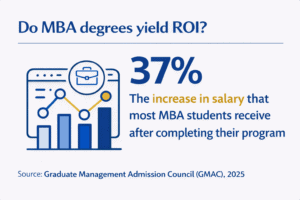
For most, increasing future earnings remains a big motivation. But does an MBA really translate into a higher salary?
The Irish Times reports that MBA graduates in Ireland are reporting significant salary uplifts after graduation. This comes with new abilities and increased responsibilities, also.
These gains are not only in the initial job but over an entire career, as an MBA often provides a quicker path to executive-level roles with greater total compensation, bonuses, and incentives. Core skills, such as financial analysis, decision-making, and organisational leadership, are highly sought after in the Irish and European job markets.
2. Career Transformation and New Directions
Career mobility is another major reason for pursuing an MBA.
An MBA helps professionals accelerate their move into leadership or change industries entirely, a point echoed by the Association of MBAs (AMBA) Ireland. The business school experience compresses years of practical and classroom learning into a concentrated period, equipping graduates to handle higher responsibility and navigate complex challenges earlier.
In dynamic sectors such as renewable energy, fintech, and health management, many Irish and European professionals are leveraging an MBA to prepare for roles that require strong business knowledge alongside technical or sectoral expertise.
3. The Power of a Professional Network
The connections made during an MBA can prove invaluable throughout your career.
Networking is a cornerstone of most business schools. Many leading Irish and European MBAs place a special emphasis on international cohorts and alumni engagement. This network can help uncover opportunities, introduce you to future employers, and even connect you with partners and investors if you’re launching your own business.
Calculating Your Investment
Before deciding, consider the total cost in context with the likely benefits.
Key expenses might include:
- Tuition fees (which can vary widely across Ireland and continental Europe)
- Study materials and course fees
- Lost earnings if you study full-time or reduce working hours
Weigh this against:
- Projected salary growth after graduating
- Average time to recoup your investment (“payback period”)
- Bonuses and long-term incentives in your sector
A QS Europe MBA report notes that for many top-ranked MBAs, the payback period is about four years, with part-time or online programmes sometimes leading to faster ROI as students remain employed.
For flexible upskilling, professional certificates and microcredentials can offer affordable alternatives to full MBAs, suitable for those seeking quick career progression or sector switching.
Beyond the Numbers: Leadership and Change
The true value of an MBA often extends beyond the financial calculation.
Modern business education in Ireland and across Europe is placing greater emphasis on soft skills, including resilience, adaptability, global perspectives, and ethical leadership. Whether you study in-person or remotely, you’ll often tackle real business problems, develop cultural sensitivity, and build confidence in decision-making.
Opportunities to collaborate with classmates from different backgrounds add a richer dimension and prepare you for leadership in international settings.
Is an MBA Right for You?
If your goal is to step into upper management, change your career, or launch a startup, an MBA could be a powerful tool for unlocking your potential. Hybrid and online MBA options now make it more feasible than ever to combine study with ongoing work from Galway to Berlin.
Ultimately, the true “worth” of an MBA goes beyond salary; it’s about growing your abilities, expanding your network, and preparing to lead in a rapidly changing European business landscape.